
There was no job more dangerous than being a bombardier during World War II! While enemy fire was obviously the greatest risk to crew members, simple accidents could also happen, sometimes resulting in terrible losses. Unfortunately, this was the case for young officer Carl H. Howald, who tragically lost his life in Europe.
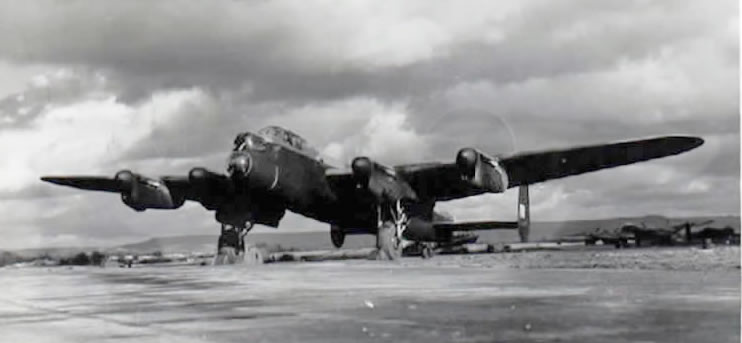
On February 4th, 1945, engine 3 of PA219, a Lancaster of the 433 Squadron (Porcupine) began its start up. The right-hand inboard Rolls-Royce V12 Merlin coughed to life, followed in succession by engines 4, 2 and finally 1. With all four propellors spinning, the Avro bomber taxied to the end of the runway at Skipton-on-Swale, Yorkshire, England. It was to take part in a 238-plane mission to bomb Bonn. After a final checklist, Flight Lieutenant (F/L) Neil Mara, DFC, released the brakes on call sign ‘Mike’ and rolled down the runway. At approximately 17:35, the aircraft lumbered into the air for its final flight. This was Mara’s 23rd trip into hostile Europe with his experienced crew. On board was one man on his first operational flight: Second Pilot, Flight Officer (F/O) C. H. Howald.
Born near Listowel, Ontario, Carl Herbert Howald was the son of Herbert and Margaret née Vogt and had joined the Royal Canadian Air Force (RCAF) on July 2, 1942. He had completed his Senior Matriculation two years prior and had been working as a Drug Apprentice for E.M. Creighton since graduation. This was considered a promising career path at the time, and it made him an attractive candidate for the RCAF, which had been given priority on high quality applicants. With his background and education, he was immediately recommended for officer training.
Like all new recruits, Carl was put through a battery of tests before beginning his flight training, and he was found to be an above average candidate. His evaluation scores show he was particularly strong in his Ground School work. Like all future bomber pilots, Howald would be taken through a succession of aircraft, starting with the slow and very forgiving Tiger Moth. He then advanced to the famous Harvard before moving onto the dual engine Oxford trainer. It was during this time in training, he met and married Ruth Katherine Waters of Stratford, Ontario on January 1, 1944. By late April of the same year, he was in the United Kingdom.
After advanced training on the Wellington bomber, Howald and his assigned crew arrived at the 433 Squadron Headquarters on December 23, 1944, just as the Porcupines were in the midst of transitioning to the more powerful Lancaster. This would require some retraining for Carl and delayed his deployment to operational status. After years of training, he was ready for his final check. He was required to fly along with an experienced crew to get a better understanding of what was involved in a raid against German targets. He would fly as a supernumerary Second Pilot. This requirement placed him aboard Mara’s PA219.

Read the rest of the article on Honouring Bravery
Article written by Kris Tozer for Honouring Bravery.