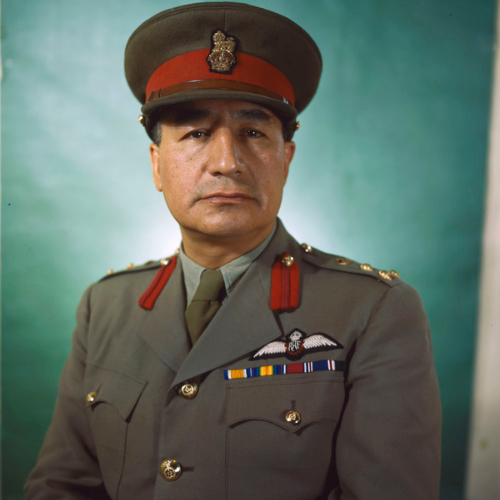
During the First and Second World Wars, thousands of Indigenous soldiers served in Canada’s military. One highly respected individual who served in both conflicts was Oliver Milton Martin.
Born in 1893 on the Six Nations Grand River Reserve, Martin was a member of the Kanyen’kehà:ka (Mohawk) Nation. He attended high school in Caledonia and joined The Haldimand Rifles (later renamed the Dufferin and Haldiman Rifles of Canada) as a bugler in 1909. Around 1913, he was selected by the Six Nations Council to receive a scholarship to go to law school. However, the Department of Indian Affairs refused to approve the Council’s request, and he was unable to go. Instead, he found work as a teacher.
Service in the First World War
In 1916, Martin enlisted in the First World War. As he was commissioned in the Haldiman Rifles, he joined the Canadian Expeditionary force as a Lieutenant. In January 1917, he was reassigned to the 107th Timberwolf Battalion and fought with the battalion in France and Belgium.
Although some First Nations soldiers felt that they were treated with respect on the battlefield by other soldiers, there were still cases of discrimination. Overseas, he was assigned to transport 400 Indigenous soldiers to a military camp. Their train had a four-hour layover in London. Senior officers told Martin that he was not allowed to let any of them off the platform as they believed that as Indigenous peoples, the soldiers would end up causing some sort of disturbance in town. Martin ignored the senior officer, risking his own commission in the process, and allowed the soldiers to leave the station. Every soldier was back on time to leave, and no disturbances occurred.
After serving with the Timberwolf battalion and surviving a German gas attack, Martin transferred to the Royal Flying Corps in late 1917. He first trained as an observer in England. Later, in June 1918, he became one of only a few Indigenous pilots in the military. While in England, he married his first wife, Irene Preece (the two later divorced in 1929). Martin returned to Canada in 1919. He continued serving part-time with the Dufferin and Haldimand Rifles of Canada and eventually became Lieutenant Colonel in 1930.
Between the wars
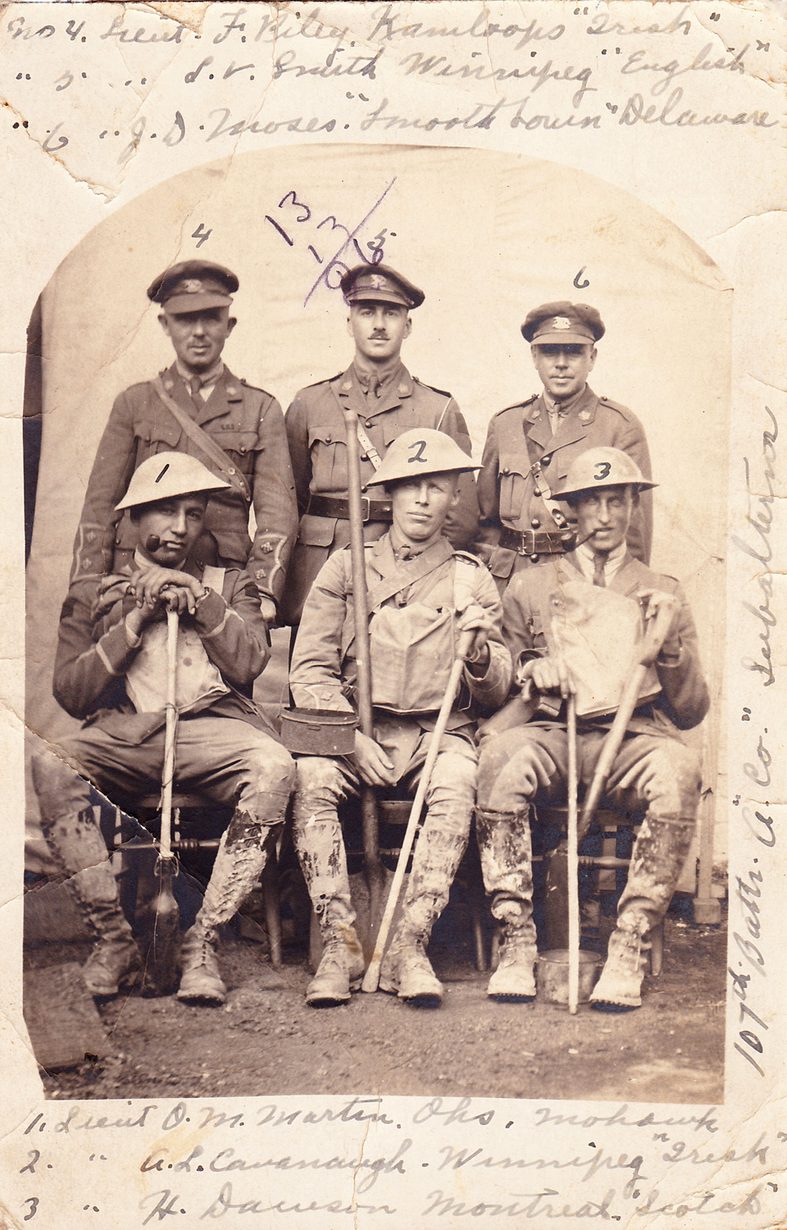
In 1921 Martin was once again teaching school on the reserve. At the time, many returning Indigenous soldiers had purchased farms on the reserve via the Soldiers Settlement Act, but some could not keep up the payments, and the properties were being resold by the Department of Indian Affairs. The local Indian agent asked him if he would like to take over one of these farms and Martin agreed, but only on the condition that he would be allowed to continue teaching on the reserve. However, three months later, he received an official notice telling him that since he had purchased the land under the act, his job as a teacher was being terminated. As a result, Martin decided to leave the reserve and voluntarily enfranchise. Martin chose to enfranchise as he felt this was the only way for him to take control of his own affairs. It is important to remember that at this time, Indigenous peoples were considered wards of the state and did not have the same rights as non-Indigenous Canadians. While enfranchisement allowed him to vote and manage his own finances, it also came at a cost. Enfranchisement meant a loss of Indian status, and, among other things, he could no longer live or buy land on the reserve.
“I left our reserve against the very definite wishes of my father and mother and all my people.”
—Oliver Martin (Special Joint Committee on Indian Act, 1946).
Lisez la suite de l’article sur Honouring Bravery
Written by Anthony Badame for Honouring Bravery.