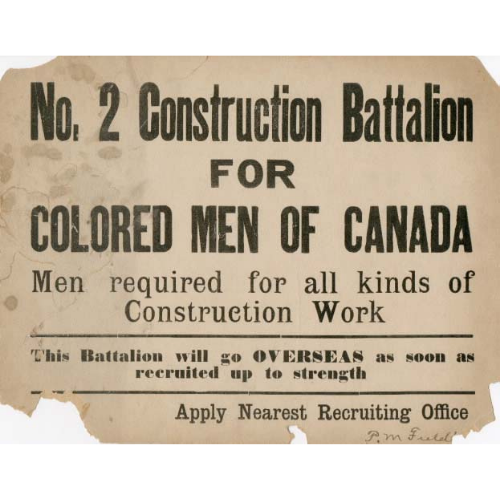
Since their rediscovery, there has been a growing amount of misinformation about the service of the No. 2 Construction Battalion. These myths diminish the contributions of these men. We owe it to them to be truthful and frank about their significant war effort and sacrifices.
March 16, 1917, the snow lay in patches on the ground as the soldiers began to form up ranks for the customary battalion photo. All of the men were wearing the uniform of the Canadian Expeditionary Force (CEF) with this unit’s distinctive shield-shaped cap badge. The contingent of musicians with their instruments led by Band Master Sergeant G. W. Steward took up their position at the rear as the other four sections fell in. Amongst the 600 enlisted men on that field were: Sergeant Albert Alberga, a Jamaican civil engineer; Charles Owens, a Pictou farmer; Thomas Reid and brothers William, Joe and Sheldon Parris, all labourers from Nova Scotia; Ontarian Henry Courtney; and British Columbian Robert Whims. Uniquely, men in this unit were drawn from the four corners of the dominion and beyond. As the soldiers settled in, former railway conductor Daniel H. Sutherland, now Lieutenant Colonel, and his officers assumed their positions in front of the formation. The shutter clicked and captured one of the most important moments in Canadian military history. It froze in time the members of the only purposefully-created, fully-segregated military unit in the CEF: the No. 2 Construction Battalion (No. 2).

For generations, the contribution of Black Canadians to our Great War efforts had been largely overlooked or forgotten. Senator Calvin W. Ruck’s book, The Black Battalion 1916-1920: Canada’s Best Kept Military Secret on No. 2 brought this lost history to light. He reignited interest in how Black Canadians answered the call to serve in the First World War. This pioneering work pulled back the curtain on the role of Black Canadians in Canada’s development as a nation.
Read the rest of the article on Honouring Bravery
Written by Kris Tozer for Honouring Bravery.