‘Welsh dash’, meaning to be brave and gallant, is a virtue much valued by the Royal Welch Fusiliers, Wales’s most senior regiment of foot. This was exemplified by Captain Edward Bell VC.
During the Crimean War, Bell famously seized a heavy Russian gun by dashing forward with little regard for his own safety before pointing his empty revolver at the drivers’ head, leading to him dismounting his horse and fleeing. For this gallant endeavour, Bell was awarded one of the Royal Welch Fusiliers’ first Victoria Crosses. The gun can still be seen today displayed at the regiments’ museum in Caernarfon Castle, North Wales. Almost a century later, this bold tradition of ‘Welsh dash’ would be again exemplified by none other than a rural Canadian farm labourer from Manitoba.
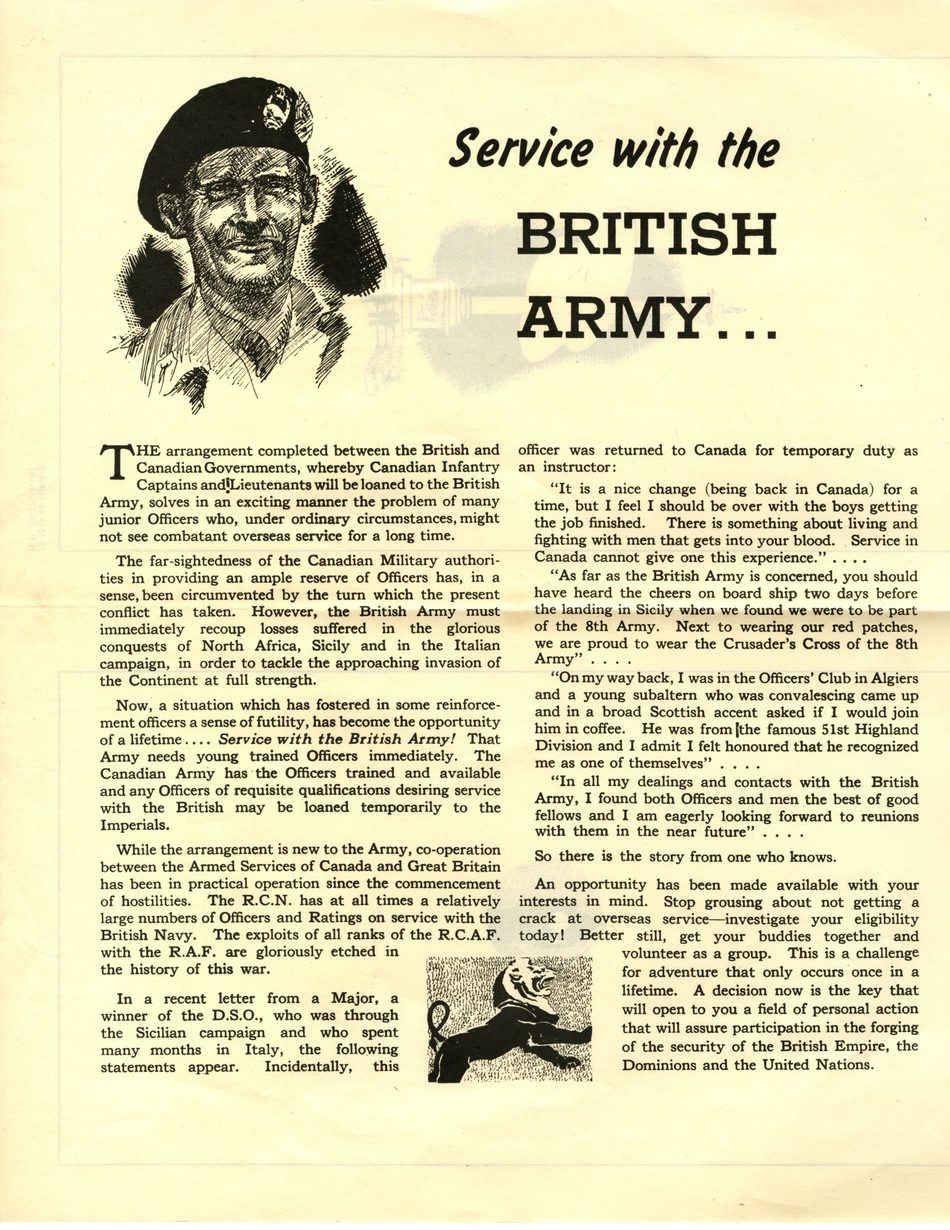
The CANLOAN Scheme
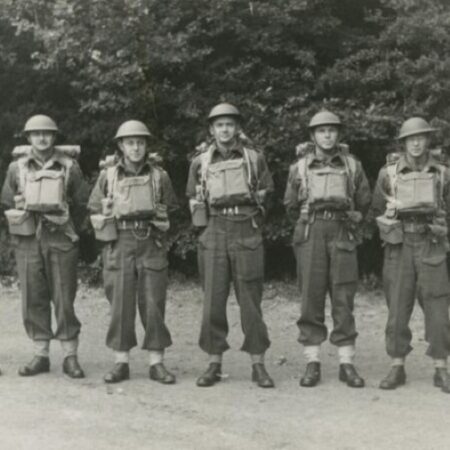
In 1942 and 1943 the British army was in crisis. Fighting a global war against the axis powers had stretched its armies beyond any reasonable measure. Compounding this issue was the rapid expansion of the British army in the leadup to an expected invasion of Northwest Europe. It was discovered that Britain could not supply the required quantity of junior officers to meet this demand. Canada, however, had the opposite problem. At this time the Canadian army had a surplus of officers, due in part to the disbanding of two Home Defence divisions. In response to these issues, the CANLOAN scheme was devised in the autumn of 1943, whereby Canadian infantrymen could volunteer to serve within British infantry regiments. In total, 673 Canadians volunteered; these officers were considered British for all purposes except pay and were given special three-digit serial numbers with the prefix CDN.
Right: Recruitment leaflet promising early action with the British Army bearing the likeness of Bernard Montgomery (source: University of Western Ontario).
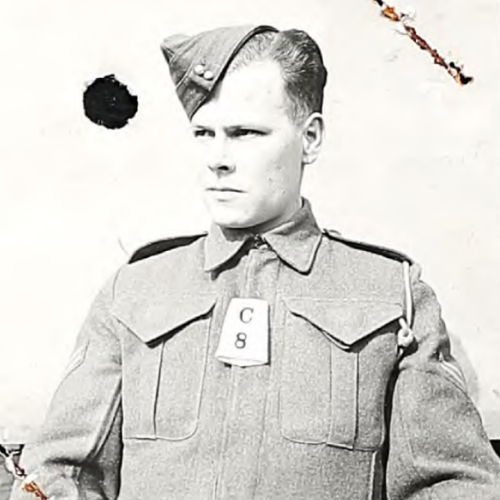
James Murray Suttie
James Murray Suttie, a “Typical young Western Canadian of the best type. An excellent representative officer for the British Army” was born on the 12th of October 1916 in Wellwood Manitoba to Mr. John Duncan Suttie and Mrs. Elizabeth Suttie, both Protestant crop farmers of Scottish descent. Suttie, a follower of the United Church of Canada and a subscribed member of his local Orange Lodge, continued practicing his parent’s Protestant traditions. At age 16, he completed the eleventh grade and left school to take up a one-year course in typing, shorthand and bookkeeping. Leading an exceptionally active lifestyle, the office life didn’t suit Suttie and he returned to his father’s 1200-acre farm in 1933. There, he enjoyed his life farming, wrestling, hunting and fishing in the Manitoba countryside with his parents and three younger brothers, William, John and Charles. When he wasn’t doing these or working, he played chess, ice hockey, baseball, collected military badges and read histories, biographies and historical novels. In 1937, as his father’s farm grew, Suttie assumed further responsibility as a ‘tax accountant’, which routinely took him 192 kilometres east to Winnipeg. It was here in Winnipeg that a 24-year-old Suttie volunteered for service with the Princess Patricia’s Light Infantry on the 5th of January 1940.
Read the rest of the article on Honouring Bravery
Article Written by Dylan Gash for Honouring Bravery.